Husky Clipper
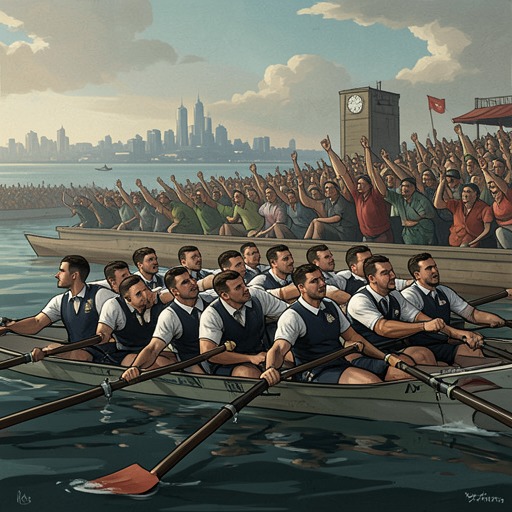
The Boys in the BoatThe Husky Clipper was the racing shell that carried the University of Washington crew from a springtime varsity trial to victory in the 1936 Olympic men’s eight in Berlin. Built to move as part of a crew rather than as a passive platform, it became inseparable from the team’s hard-won coordination; after its competitive career, repeated reunion rows and public display gave the boat a second life as a material link between the crew and the generations who followed them.
Construction and identity
The Husky Clipper was one of George Pocock’s latest racing shells, built for speed but also for the responsive movement that distinguished his designs. At sixty-two feet long, it was matched in size and weight by the California Clipper. The paired boats weighed within a pound or two of one another, and the Washington crew itself outweighed its California rivals by only four pounds: 1,561 pounds to 1,557. The comparison made the shells’ construction and the crews’ handling, rather than a striking difference in mass, part of the contest.
The shell’s cedar skin was five-thirty-seconds of an inch thick. Yellow cedar washboards, ash frames, Sitka-spruce gunnels, and fore and after decking made of silk impregnated with varnish completed its carefully assembled structure. Most distinctive was the slight curvature, or camber, of George Pocock’s design. That shape gave the shell compression, spring, and liveliness in the water. Its character thus lay not only in light materials but in how those materials responded to the crew’s strokes: the race would ultimately turn on watermanship and nerve, but the boat was built to transmit their coordinated effort.
The name was formally given to a new shell in March 1936, after Al Ulbrickson had elevated the crew to varsity status. As the rowers held it aloft, George Pocock poured a jar of fluid over its bow and announced, “I christen this boat Husky Clipper. May it have success in all the waters it speeds over. Especially in Berlin.” The fluid was sauerkraut juice, a joke that made the crew’s distant Olympic destination part of the boat’s naming ceremony. The playful gesture was also a declaration of purpose: the new shell was intended for the trials and, if the crew earned the chance, the German waters beyond them.
From trials to the coast race
The boat’s first performances quickly justified the hopes attached to it. In a three-mile time trial on April 4, Bobby Moch raised the rate to thirty-two two miles into the course. The crew finished in 16:20, improving on the previous course record of 16:33.4, and sat upright at the finish, breathing easily. The result offered a concrete measure of the boat and crew’s growing effectiveness: the shell was not simply crossing the course faster; the rowers appeared to have reserve left when they arrived.
In the race against the California Clipper, the boats were unusually well matched. Both had state-of-the-art cedar construction and Pocock’s camber; neither offered an obvious physical advantage. California took an early lead, and for three-quarters of a mile its stroke, Gene Berkenkamp, held Washington off. Bobby Moch then ordered Don Hume to reduce the rate to twenty-nine. The lower rhythm let the University of Washington crew find its swing: Hume’s long, smooth pulls set the pattern, and the other rowers followed. Seat by seat, the Husky Clipper recovered water and moved ahead.
Moch declined to answer California’s repeated bursts with matching surges. Even when the rival crew called for hard strokes, he kept the Husky Clipper steady. Near the two-mile buoy, California’s shell rolled slightly off keel twice, and two starboard rowers failed to release cleanly from the water, interruptions that broke their rhythm. Washington built a three-quarter-length lead. With half a mile remaining, Moch finally told Hume to raise the rate to thirty-two. The Husky Clipper accelerated through the chop and crossed three lengths ahead. Both boats beat the old course record, but Washington’s time of 15:56.4 put it thirty-seven seconds under the previous mark. The winning shell carried a crew whose restraint early in the race had made its finishing speed possible.
The Berlin races
Berlin tested the shell in weather and circumstances unlike the spring races on Lake Washington. Before the Olympic competition, a photographer who had crawled beneath the Husky Clipper stood up too quickly and struck its hull, opening a long, thin crack. The boat was out of commission until George Pocock repaired it. When it returned to the water, the crew rowed badly: timing was off, pulls were weak, and Canadian and Australian crews passed them during sprint practice. The setback exposed how dependent a racing shell’s speed was on the crew’s form and timing; the repair restored the boat, but it could not by itself restore the rowers’ rhythm.
Against the British crew, the Husky Clipper was in a close final push. With 250 meters left, Moch called for ten hard strokes, and the American bow began to draw level with the British shell. At 150 meters, Britain still led, but the Washington rowers had found their swing and were holding it. They drove through the final twenty strokes, particularly the last twelve, and passed the British boat by twenty feet. Don Hume collapsed forward across his oar after the finish; when he could sit upright again, the crew learned that its time of 6:00.8 was a new course record and a new world and Olympic record.
The Olympic final began with a more damaging disruption. At the start on the Langer See, Bobby Moch did not hear the starter or see the flag; Noel Duckworth, coxswain of the British boat, apparently missed it too. Four boats surged away while the Husky Clipper and the British shell remained motionless at the line. The Washington crew had to recover from the lost start in a field already moving toward the finish. As the race unfolded, the shell advanced from fifth to third, but with five hundred meters remaining it was still nearly a length behind Germany and Italy.
The Husky Clipper’s final charge came when the course narrowed into more sheltered water. Moch eased the rudder parallel to the hull, and the shell began to run freely. At 300 meters, its bow was roughly level with the German and Italian boats; approaching the last 200 meters, it moved ahead by about a third of a length. Moch counted strokes down and then restarted the count, keeping the rowers committed to an effort they could not yet know was near its end. The eight oars bent under the strain, and the shell’s cedar prow cut forward through the water. Hume raised the rate as the three leading boats fought for the line; the Washington crew reached forty-four strokes per minute, higher than it had ever rowed. All three boats crossed in the same second. The Husky Clipper’s victory made it the shell of the gold-medal crew, but the contest had shown that its speed depended on a fragile joining of shell, coxswain, stroke, and every rower’s timing.
A vessel of return and remembrance
The Husky Clipper continued to bring the crew together after their competitive careers diverged. For the ten-year anniversary in 1946, the nine rowers removed it from its rack, dressed in shorts and sweatshirts, and took it onto Lake Washington. Moch raised the rate to twenty-six, and the crew rowed back and forth before news cameras. They rowed together again in 1956. By the fortieth anniversary in 1976, only eight remained; their shoulders sagged and their hair had grayed, but the shell still carried them through crisp, clean, efficient strokes. In 1986, fifty years after Berlin, the surviving rowers pushed it down to the lake on a wheeled cart. With aching backs and troubled joints, they boarded carefully and made one last row together before carrying their oars back to the shell house.
The boat’s public life also changed. For years it rested mostly unused in the old shell house, apart from anniversary rows, and during part of the 1960s it was on loan to Pacific Lutheran University in Tacoma. In 1967, the University of Washington requested its return, restored it, and displayed it in the student union. It was later shown at the George Pocock Memorial Rowing Center before moving to the University of Washington Conibear Shellhouse. There it hangs from the ceiling of the dining commons, its cedar and spruce lit above a view of Lake Washington. The shell remains a tangible survivor of the Olympic crew: visitors photograph it and tell one another what they know about the rowers who took it to Berlin.
Its significance now reaches beyond the race results. Every fall, several hundred prospective freshmen gather beneath the Husky Clipper as coaches explain the demands of rowing and the history of the University of Washington program. The shell turns that history into something visible above the room: a boat once propelled by nine rowers, now suspended where new crews hear how difficult the work will be and what it means to earn a place in it. Its continued presence preserves the distinction at the heart of its story: the Husky Clipper was an actual cedar shell, but its lasting meaning rests in the shared effort it carried and the memory that effort left behind.